A dark matter halo is a potentially confusing name as it doesn’t actually resemble a ring like an angel’s halo. Instead a halo is more easily thought of as a roughly spherical cloud of dark matter particles that are physically held together by gravity. Astrophysicists are especially interested in the shape of these halos as they directly pull on the matter we can see like galaxies and stars influencing the motion and interactions of things we do see.
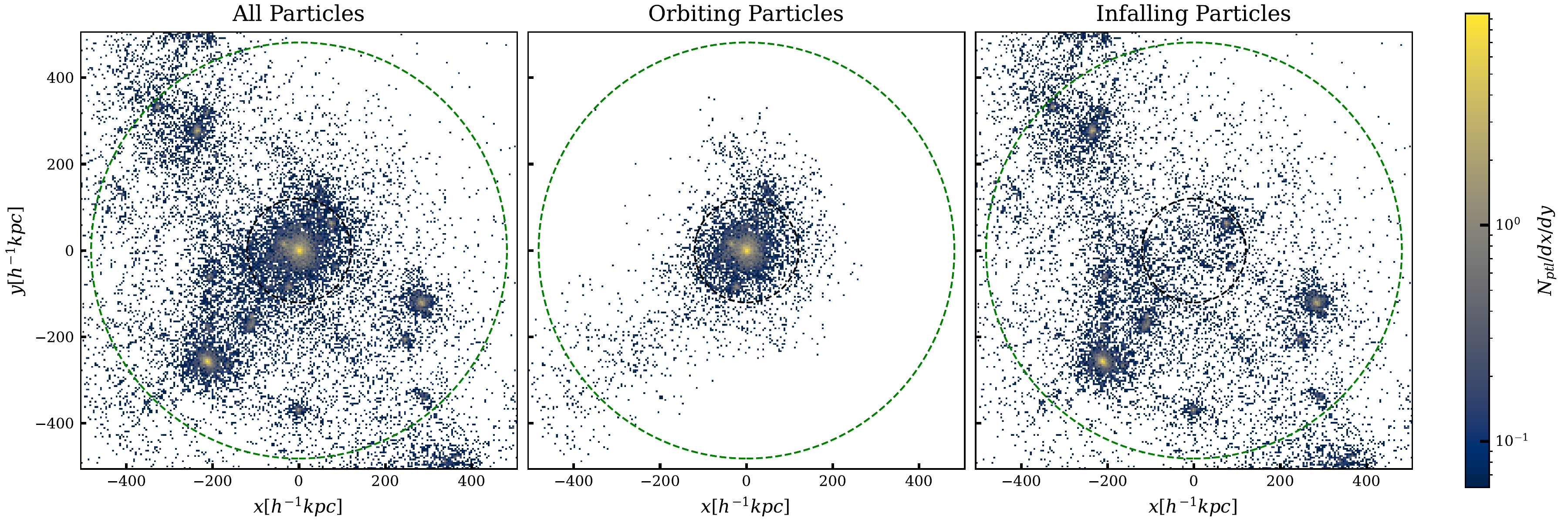
A flattened 2-D view of the dark matter particles of a random halo taken from an N-body Simulation. We are looking at a dark matter halo in space with the x and y axes representing the positions from the halo's center. The color can be interpreted as the number of particles in each area of the graph. It is more yellow closer to the center since there are more particles in the center of a halo. Additionally, besides the large halo in the center we see other, smaller, halos in the same area and then a smattering of additional particles in between.
The plot is divided into three panels showing the same place in space but with different filters applied. The left panel depicts all the particles in this space. The middle and right panels then split up the particles based off definitions from a particle tracker. This particle tracker looks at where the particles are and were in the past and determines if they are orbiting, and are part of the main halo, or are infalling, and are not part of the halo.
With a better understanding of what this figure represents we can learn a lot about dark matter halos. We see that they are more dense towards the center (very yellow) and steadily have less and less particles the further you go (more and more blue). Additionally, we see that although the halo is roughly a circle (and so a sphere in 3D) it isn't exactly with some areas having more particles than other areas.
This is actually an extremely important observation, and defining what actually is a dark matter is still a subject of debate today. Traditionally scientists would decide a boundary based off some criterion, generally when the halo was no longer significantly more dense than the surrounding area. However, there is significant variability in this definition and it isn’t physically motivated. An alternative method, which I worked on with Dr. Benedikt Diemer, is to instead look at how the particles themselves are moving. The idea is that particles that actually belong to the halo will be moving in a certain way where they orbit the center of the halo while particles that are just passing through or don’t belong to the halo yet will have different motions. This method allows us to more physically define the halo. See the Additional Info box for more detailed info on why this matters.
Additional Info
Slice of a dark matter halo from an N-body Simulation. The left panel depicts a 2D projection centered on the halo. The middle and right panels then display the infalling and orbiting populations as described by SPARTA, . The black circle indicates the traditional R200m halo radius.
Why should I care?
Under our current theory of the universe dark matter halos are believed to have a significant impact on the formation and evolution of galaxies. The Milky Way, the galaxy we live in, is inherently affected by the dark matter halo it is in and the dark matter halos of other nearby galaxies.
Additionally, understanding the details of dark matter halos like their range in sizes, shapes, and evolution is a great way to better understand what dark matter itself is. See Ursa Major III - UNIONS 1 Overview for more details about how we can use some of the smallest galaxies in the universe can teach us about the particle that makes up 27% of the universe.
How can we learn about what we can’t see?
Due to the nature of dark matter being dark and dark matter halos solely consisting of these particles it is impossible to directly observe these particles. See dark matter: Observing What Can’t be Observed for more details on how we are able to see strong evidence that these structures do in fact exist. Being unobservable does mean that they are significantly much more difficult to learn about than other astrophysical objects like stars and galaxies which one can even see with the naked eye. One popular method
Benedikt Diemer: The Splashback Radius A description of an alternative definition to the spherical overdensity criterion. Includes a list of good papers on the subject!